
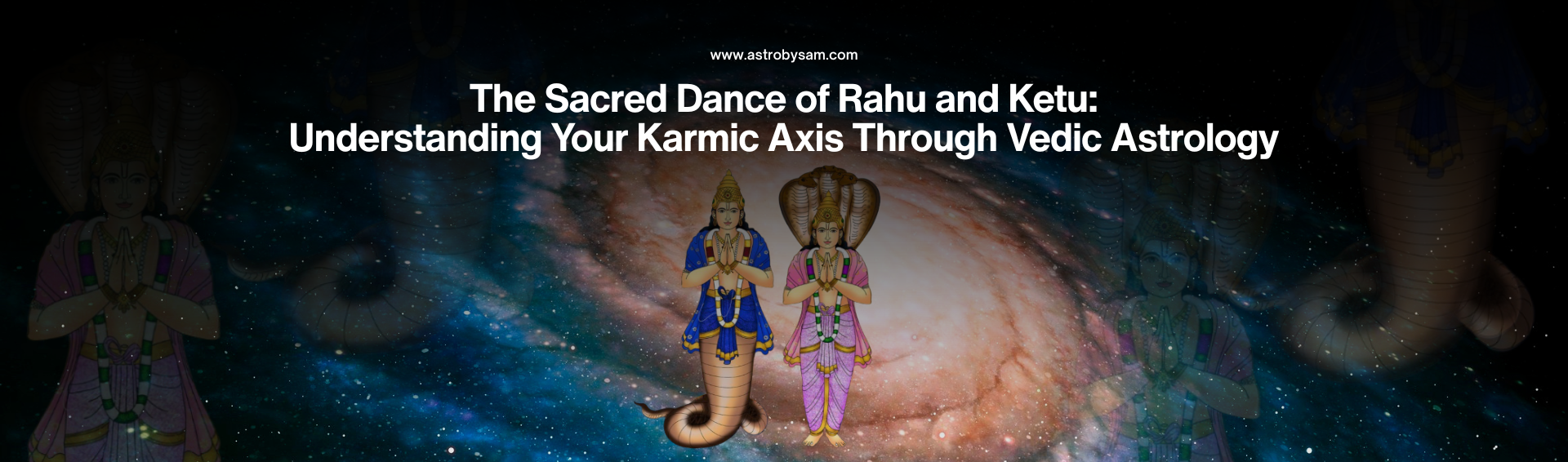
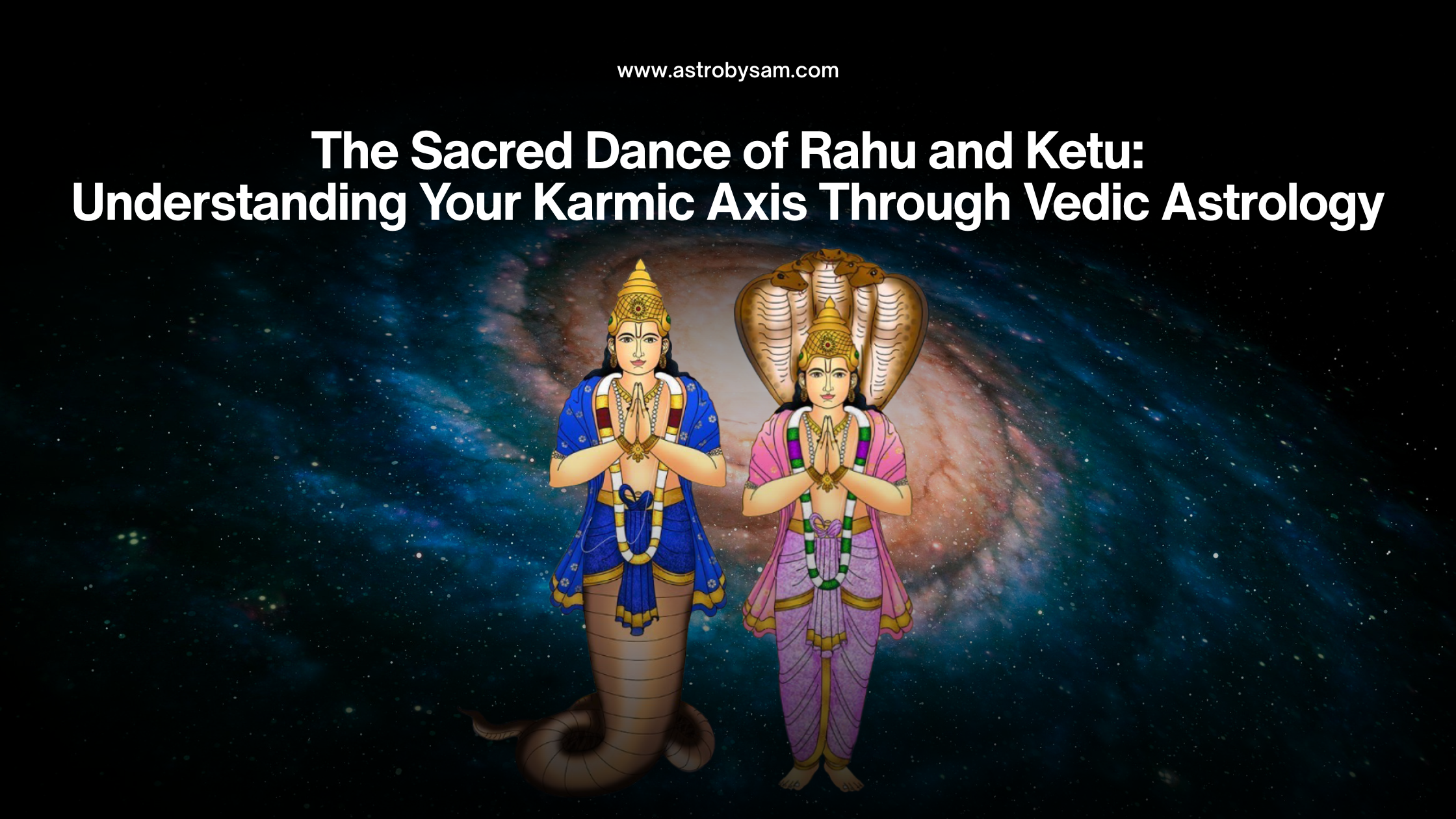
The Sacred Dance of Rahu and Ketu: Understanding Your Karmic Axis Through Vedic Astrology
In the mystical world of Vedic astrology, few forces are as mysterious and transformative as Rahu Ketu — the shadow planets known as the north and south lunar nodes. Unlike visible celestial bodies in the solar system, Rahu and Ketu are not real planets. They are mathematical points in space created where the Moon’s orbit intersects the path of the Sun. These nodes of the Moon are deeply connected to karma, eclipses, destiny, attachment, liberation, and the soul’s evolution.
In Jyotish, the ancient system of Indian astrology, Rahu represents worldly desire, obsession, illusion, and expansion, while Ketu represents detachment, spiritual wisdom, and moksha. Together, these shadow planets create a karmic axis in the Vedic astrology chart that reveals the soul’s life purpose and karmas carried across lifetimes.
The north and south nodes always sit 180 degrees apart in the zodiac, forming one of the most important axes in a Vedic astrology birth chart. Rahu is the north node of the Moon, while Ketu is the south node. Their movements influence eclipses, karmic patterns, subconscious tendencies, and personal growth.
The Mythological Origin of Rahu and Ketu In Vedic Astrology
According to Hindu mythology, during the churning of the cosmic ocean, known as Samudra Manthan, the devas and asuras searched for the nectar of immortality. One asura disguised himself among the gods and drank the sacred nectar before Vishnu discovered him.
As Vishnu severed the asura’s head, the immortal being split into two:
Rahu became the immortal head.
Ketu became the immortal body.
Because the nectar of immortality had already touched him, both survived as eternal cosmic entities.
This myth explains why Rahu’s energy is associated with insatiable hunger, illusion, worldly ambition, and desires that are never satisfied, while Ketu’s energy represents spiritual detachment, renunciation, and liberation from material attachment.
These shadow planets also symbolize the north and south lunar nodes responsible for solar and lunar eclipses.
Rahu and Ketu Energies
Unlike physical planets, Rahu and Ketu are invisible points in space, but their influence in astrology is considered extremely powerful.
In Vedic astrology:
Rahu represents obsession, ambition, foreign influence, illusion, unconventional experiences, and material cravings.
Ketu represents spiritual wisdom, detachment, inner awakening, past-life mastery, and moksha.
The nodal axis in a Vedic astrology chart often reveals where the soul feels both attraction and discomfort simultaneously. Rahu pushes the soul toward experiences it has never mastered before. Ketu pulls the soul toward familiar karmic patterns and past-life comfort zones. Together, Rahu and Ketu energies illuminate the deeper spiritual journey hidden inside the birth chart.
Why Rahu and Ketu Matter in the Birth Chart
The placement of Rahu and Ketu in different houses of the zodiac can reveal:
Karmic lessons,
Subconscious mind patterns,
Spiritual growth,
Life purpose,
Attachment and detachment,
Hidden fears,
And areas of transformation.
Because Rahu and Ketu are always 180 degrees apart, every placement creates an axis of growth.
For example:
Rahu in the 1st house automatically creates Ketu in the 7th house.
Rahu in the 10th house creates Ketu in the 4th house.
Rahu in the 5th house creates Ketu in the 11th house.
This axis represents the balance between worldly ambition and spiritual evolution.
Rahu in the Houses
Rahu in the 1st House
Rahu in the first house creates a powerful desire for identity, independence, visibility, and recognition. These individuals often reinvent themselves repeatedly and may feel driven toward fame, leadership, or unconventional self-expression.
Rahu in the 1st house pushes the soul toward personal growth and self-discovery.
Rahu in the 2nd House
This placement creates attachment to wealth, speech, family lineage, and material security. Rahu in the 2nd house may generate sudden financial rise, unusual communication patterns, or obsession with status.
Rahu in the 3rd House
Rahu in the 3rd house often creates fearless communicators, entrepreneurs, performers, or media personalities. This placement favors courage, networking, communication, and victory over enemies.
Rahu in the 4th House
Rahu in the 4th house can create emotional instability or detachment from home. The person may search for emotional fulfillment through material comforts, relocation, or external success.
Rahu in the 5th House
This placement intensifies creativity, romance, speculation, intelligence, and desire for recognition. Rahu in the 5th house often produces unconventional thinkers or people drawn toward fame and influence.
Rahu in the 6th House
Rahu in the 6th house can bring immense competitive power, service to others, and the ability to overcome enemies or obstacles through persistence.
Rahu in the 7th House
Rahu in the 7th house creates strong karmic relationships and fascination with partnerships, foreign connections, or unconventional marriages.
Rahu in the 8th House
Rahu in the 8th house creates attraction toward occult subjects, hidden knowledge, transformation, psychology, and taboo experiences.
Rahu in the 9th House
This placement often creates rebellion against traditional beliefs while encouraging spiritual exploration, foreign travel, and philosophical growth.
Rahu in the 10th House
Rahu in the 10th house creates intense ambition, desire for status, public recognition, and professional success. These individuals often pursue unconventional careers or leadership roles.
Rahu in the 11th House
This placement amplifies social influence, networking ability, and material gains. Rahu in the 11th house often attracts powerful social circles and large ambitions.
Rahu in the 12th House
Rahu in the 12th house creates fascination with spirituality, foreign lands, hidden dimensions, dreams, and the subconscious mind.
Ketu in the Houses
Ketu in the 1st House
Ketu in the 1st house creates spiritual detachment from identity and ego. The individual may feel inwardly disconnected from worldly recognition.
Ketu in the 2nd House
Ketu in the 2nd house often creates detachment from wealth, family structures, or material possessions.
Ketu in the 3rd House
Ketu in the 3rd house may produce introversion, unusual communication styles, or detachment from social validation.
Ketu in the 4th House
This placement often indicates detachment from home, emotional security, or family life.
Ketu in the 5th House
Ketu in the 5th house creates spiritual intelligence, intuitive creativity, and detachment from romance or recognition.
Ketu in the 6th House
Ketu in the 6th house may create a karmic need to overcome internal fears, health issues, or service-related responsibilities.
Ketu in the 7th House
Ketu in the 7th house often produces emotional distance in relationships and teaches lessons about balance between self and others.
Ketu in the 8th House
Ketu in the 8th house intensifies mystical tendencies, transformation, and interest in hidden spiritual truths.
Ketu in the 9th House
Ketu in the 9th house creates detachment from rigid belief systems while encouraging deeper spiritual inquiry.
Ketu in the 10th House
Ketu in the 10th house can create detachment from career, status, or public image despite professional success.
Ketu in the 11th House
This placement creates emotional distance from social circles, popularity, or material ambitions.
Ketu in the 12th House
Ketu in the 12th house strongly supports spirituality, moksha, meditation, isolation, and liberation from worldly attachment.
Rahu and Ketu Through Nakshatra
In Jyotish, nakshatra placements refine the interpretation of Rahu and Ketu energies.
The nakshatra influences:
Subconscious desires,
Karmic tendencies,
Emotional reactions,
Spiritual lessons,
And destiny patterns.
Astrologers carefully analyze the Moon’s nakshatra alongside the nodal placements to understand the soul’s deeper karmas.
Rahu, Ketu, and Malefic Influence
Though Rahu and Ketu are considered malefic in classical astrology, their purpose is not punishment. Instead, they accelerate spiritual growth through intense life experiences.
Rahu creates obsession so the soul eventually learns detachment.
Ketu creates detachment so the soul eventually discovers inner truth.
This sacred tension drives evolution.
The Spiritual Meaning of the Nodes
The north node and south node are not enemies.
They are complementary teachers.
Rahu teaches expansion through worldly experience.
Ketu teaches liberation through surrender.
The soul evolves by balancing both.
Too much Rahu creates endless craving.
Too much Ketu creates escapism or withdrawal.
The highest wisdom emerges when the soul learns to walk the middle path.
Final Thoughts
The sacred dance of Rahu and Ketu is ultimately the story of the soul itself.
In every Vedic astrology birth chart, these shadow planets reveal:
what the soul is hungry for,
what it must release,
and where transformation becomes possible.
Rahu represents the future.
Ketu represents the past.
One pulls you forward.
The other asks you to let go.
Together, the north and south lunar nodes illuminate the path between karma and liberation, worldly ambition and spiritual awakening, attachment and freedom. Your life purpose lives somewhere along that axis. And understanding Rahu Ketu may be one of the deepest ways to understand yourself.